Back Yard Fruit
An old post on gift economies and local quirks.

This piece was first published on reddit back in 2021.
It’s a shocking thing for me to confess, but here goes. My husband and I buy feijoas. Last year, we were getting them regularly from the supermarket when they were in season. Upwards of $7 a kilo, too. Yeah, I know.
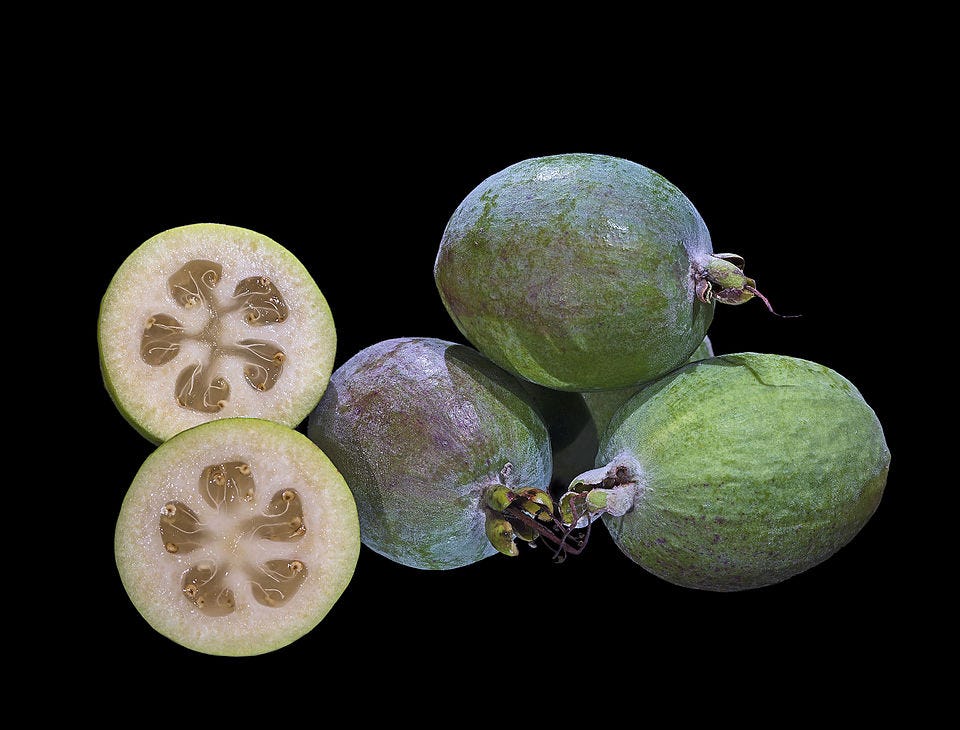
You’re not supposed to buy feijoas. You’re supposed to get them from a neighbour, if you don’t have a tree of your own. Someone will know someone who has too many feijoas, it being the nature of fruit trees to be maddeningly profuse, and in a few days, after the right requests have been passed back and forth along the right channels, you’ll find yourself with a couple of large plastic bags of fat, finger-length, green ellipsoid mysteries.
This is where the fun really starts. Commercially grown fruits select for reliable strains, because people want to know what they are buying. A tree that may have been in someone’s back yard for decades is less obliging. Little child fingers, businesslike Mum fingers, and large hairy Dad fingers go questing into the bag, squeezing gently. The rock-like ones will need a few more days. The really soft ones are probably bruised. The rest exist within a spectrum of fleshy to jelly-like that is almost impossible to figure out without cutting into the fruit.
The fleshy part of the feijoa is grainy but full of sharp flavour. The jelly is sweet and smooth. The perfect balance between the two is somehow both smooth and flavourful, and all the more precious because you never know when or if you’ll find another one that tastes quite like it. If you’re feeling sociable, you might pass the other half to someone else to prove how good this one was. If you’re not feeling sociable, you’ll hoard it for yourself, one more bite before it’s gone of the perfect feijoa that you may never see again.
In flavour and indeed in variability, commercial feijoas are not that different to gifted ones. But it’s the principle of the thing. You’re not supposed to buy feijoas. Most supermarkets don’t even stock them. Ours does. Here in the central city, back yards are scarce, and people still want feijoas. The market is stepping in where the gift economy fails.
Back yard fruit was a recurring feature of my childhood. Prior to adulthood I had never even considered that supermarkets might stock lemons. Lemons come from your tree, in your yard. That is where lemons come from. Of course, there were evidently some people out there without trees, who were in need of lemons, but I mostly understood this in the context of the people who took our excess lemons from the box outside our front gate. It must be very tricky for them when they couldn’t find lemons from us, I thought, naively. Perhaps they had to find substitutes, in recipes?
My parents had very different attitudes towards the fruit from other people’s trees. My mother would frown and fidget when she saw plums or pears that had dropped over somebody’s fence and were rotting on the pavement. “I wonder if they would let me pick them up and make jam out of them or something,” she would muse. My mother was parsimonious to the point of re-using tea bags, and the waste bothered her.
My father, by contrast, would have been mortified by the suggestion of going up to someone else and asking for their excess, even if they evidently weren’t using it. To some extent, I think this difference is one of class: my mother grew up poor, and my father did not. But I think, also, this might be a reflection of where they each grew up. Both of my parents are New Zealanders, but my father’s father was a telephone engineer who worked for the United Nations. My father spent most of his childhood overseas. My mother, by contrast, had never even been out of New Zealand until she was, I think, thirty-four? Some such late age, at any rate.
Some back yard fruit is uncontested public property. In Christchurch, vast areas of the city where people used to live have been declared uninhabitable due to the damage from the February 2011 earthquake. Fruit trees still grow in the gardens of those abandoned houses, and foraging from them has become a popular activity. The Christchurch City Council has expanded on this, and its website now lists public places where fruit is free to take.
McKendry Park in Blenheim does a similar thing, in the form of a public plum orchard. Trees have been planted with a wide variety of plum variants. At the right time of year, you can visit the park and wander from tree to tree, sampling from each and comparing flavours.
Fruit from public land is lovely, of course, but it’s not the same as the gift economy exemplified by feijoas. Gift economies necessitate community in a unique way. Sometimes they even develop reciprocality, like when my mother used to send excess plum jam (made from our tree, of course) to our neighbours that we knew, down the street, and they would respond with baked goods in a week or two.
Store-bought feijoas make up for a gap in the gift economy. They also put that gift economy at risk. A relationship-based transaction is replaced with an impersonal exchange of money for goods. An impetus to make connections with other people is lost.
The apartment building in which I live likes to foster community. We have social events, a couple of times a year. We say hello to each other in the stairwell. Beside the front door there’s a table where we leave things for other people to take. Nobody is growing so much fruit that they have excess, of course, not with our tiny potted plants or even with the veggie box that one of my neighbours has on the roof. But people leave books, and magazines, and occasionally excess electronics.
This year, it would appear that somebody knows somebody. As I went to step out the door, this morning, I saw a paper bag full of fruit. Stapled to it was a note. “It’s feijoa time,” it said. “Enjoy!”
Right-thinking readers will be relieved to learn that, in the years since publishing this piece, we’ve found some more respectable sources of feijoas. The fruit-and-vegetable seller at our nearest farmers’ market sells feijoas when they are in season, and indeed occasionally has other products sourced from somebody’s backyard. He and my husband know each other pretty well, by now, so buying feijoas from him isn’t so bad.
Of course, now that I’ve become religious I also get feijoas from my Quaker meeting. In fact, I would probably get them from my Quaker meeting more often, were it not that there are so many people there with feijoa trees that some of us are rather tired of having to help eat the fruits, leading to a sense that perhaps people shouldn’t bring them in. This leads to a slightly stealthier gift economy of feijoa products, such as chutney. Last Sunday, it was feijoa cake.