
Liberal Thoughts on Recent Reading
Lefebvre, Jacobs, Rosenblatt; religion, science, humanity

I. Intro
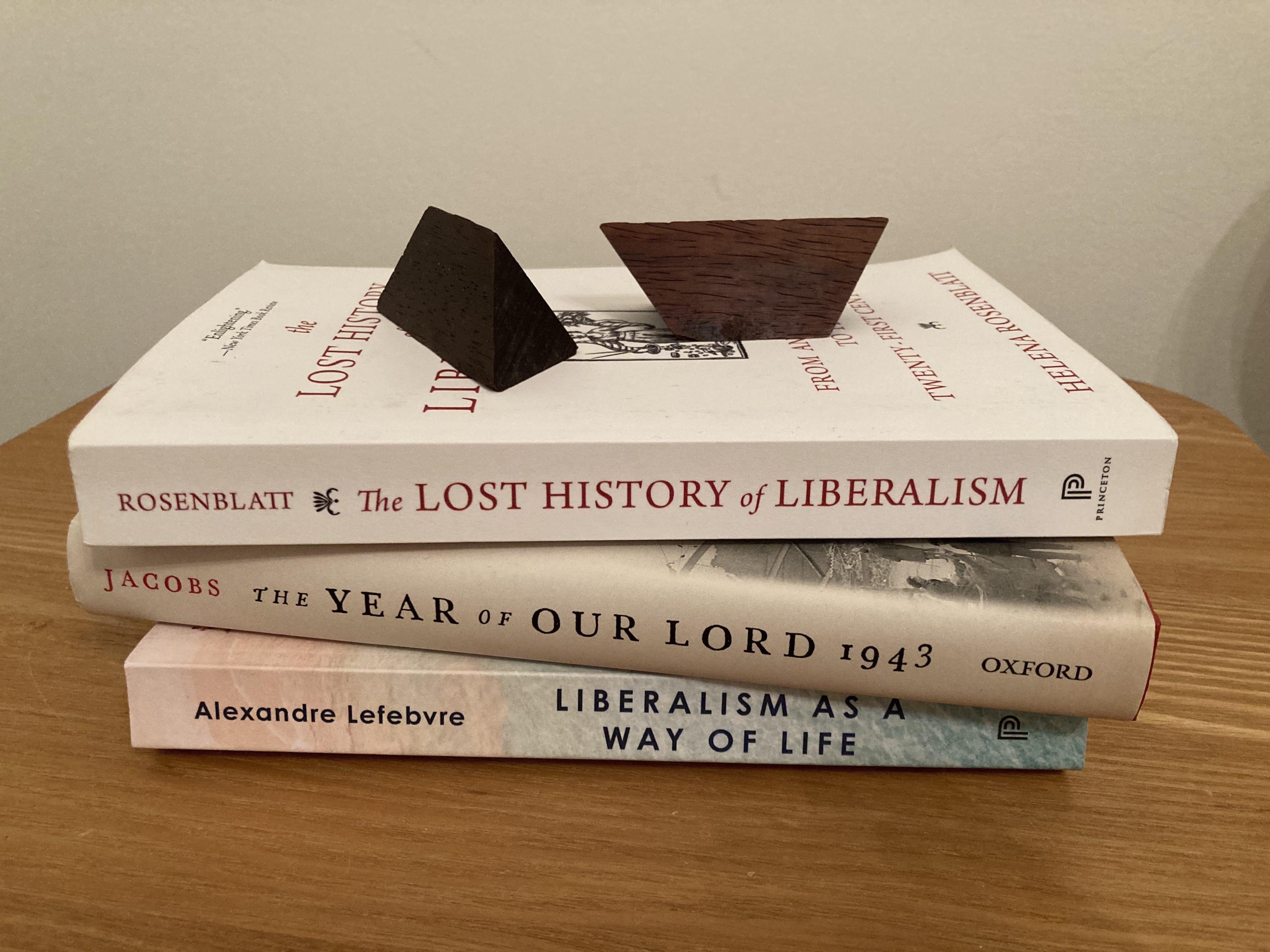
It’s time for a good babble about what I’ve been reading lately: praise, complaints, commentary, digressions on minor points. My most recent trio has been, in this order:
Liberalism as a Way of Life, Alexandre Lefebvre
The Year of Our Lord 1943: Christian Humanism in an Age of Crisis, Alan Jacobs
The Lost History of Liberalism: From Ancient Rome to the Twenty-First Century, Helena Rosenblatt
I wanted to read Lefebvre and Rosenblatt because the question of how to reinvent liberalism is receiving a fair bit of attention, at the moment1, and those two references come up a lot. Liberalism as a Way of Life is an exhortation to secular liberals to make a thoughtful personal worldview from the ambient public liberalism that we live in. It is at least partly inspired by The Lost History of Liberalism, which emphasises the moral content of pre-twentieth-century liberalism, particularly as it developed in France and Germany after the French Revolution of 1789.
I ordered The Year of Our Lord 1943 alongside these two books on a whim. This turns out to have been an excellent idea. Rosenblatt, Lefebvre, and many others would like to combat authoritarianism by demonstrating a pluralist liberalism that can sustain the kind of personal morality necessary to contribute to the stability of the liberal public square. The Year of Our Lord 1943 takes us back to a time when fear of authoritarianism was even higher than it is now—but in this book, it is Christians who are trying to craft a more compelling alternative.
Today’s would-be social engineers might learn a lot from Jacobs’ history. Looking at Jacques Maritain, Simone Weil, C. S. Lewis, W. H. Auden and T. S. Eliot, Jacobs argues that there are some common threads in the ways these Christian writers tried to build a more human, moral, Christian alternative to a world that was being transformed by technological power. They wanted to nurture the artistic, the local, the seemingly apolitical. Crucially, according to Jacobs, they failed. Instead, we have found ourselves in a world of technological managerialism.
Arguably, it is this failure that Lefebvre and Rosenblatt are responding to. Indeed, Rosenblatt maintains that our current perception of the liberal political system as a largely impersonal structure is a product of the post-WWII order. Unlike the writers that Jacobs follows, Lefebvre and Rosenblatt would not declare that Christianity is the best answer for delivering a sense of common purpose that respects individual human beings, but they are perhaps asking a similar question, updated for the current times.
II. Integrity within the Liberal Order
Consciously preaching to a choir that may not know it is a choir, Lefebvre lists advantages of being a secular liberal that double as moral exhortations to secular liberals. The impartiality and autonomy of a liberal, he says, help us to value equality, and lessen the hold of pride and snobbery on us, while fostering gratitude for the free society we live in. Liberals delight in positive diversity, know how to live and let live, and keep civil and cool even when disagreements become more serious. Moreover, he suggests that liberals are best placed for integrity in a liberal society. “[A] liberal way of life is uniquely unified,” he says.
We alone combine, in our lived existence, the right and the good, the reasonable and rational, and the just and desirable. We alone are whole, and not riven by tensions between our personal and our public moral commitments, or divisions between what we privately desire and what we publicly confess. We are liberal all the way down.
Lefebvre understands liberal religion as a personal worldview that has been modified—perhaps even adulterated—by the liberal public square. Religion, on a personal level, can be any shape at all, provided it is vaguely in the form of a little Lego person with an appropriate connector on your head, which must then be attached to a separate, liberal societal order. If that’s your perspective, then of course you would think of being “liberal all the way down” as the position of greatest cohesion and integrity. But you’d be wrong.
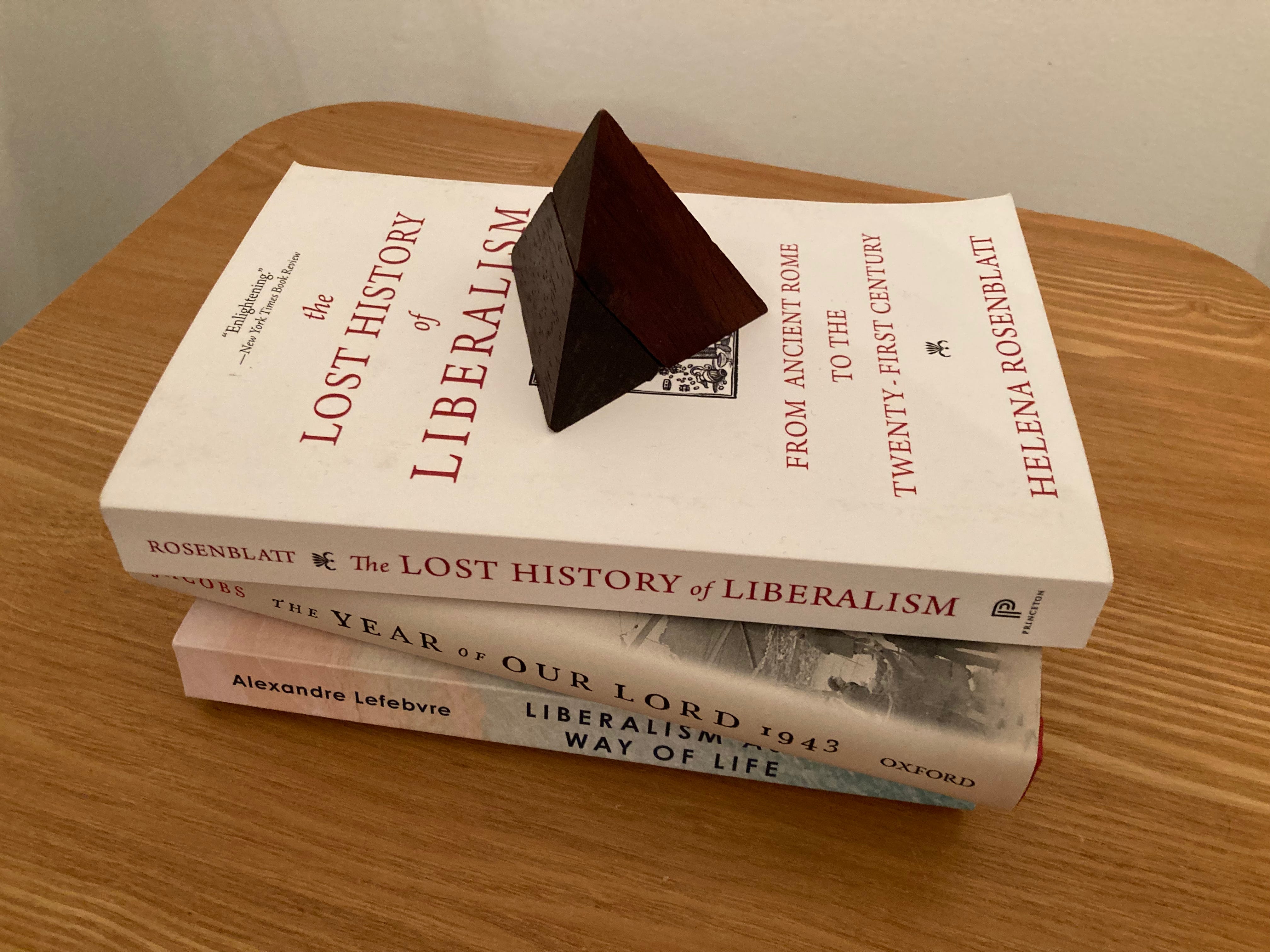
I’ve been worshiping with liberal Quakers for about four years now. The connections between Quaker beliefs and liberal principles are not well described by the Lego analogy. I’d say it’s more like a jigsaw puzzle, or perhaps like one of those wooden coffee table puzzles that seem like they’re made of a few odd pieces, but then you stare at them for a while and you start thinking “Wait, hold on, this piece goes here, and this piece goes here…” and then before you know it you’ve made a cohesive shape that you didn’t expect.
This is not so surprising. Many of the architects of liberalism were Protestants. Of course there are synergies that can arise between liberalism and certain kinds of religion. You might as well be surprised to find that, in addition to producing serotonin, your body also has serotonin receptors. They developed together!
Quakers believe that anyone can look inside themselves and encounter moral and spiritual truth. Like many Protestants, this starts with “You don’t have to be a priest.” Unlike many Protestants, it extends all the way out to “You don’t even have to be Christian.” This latter proposition is controversial, and there exist offshoots that have chosen to repudiate it, but it has been part of the Society of Friends from the first.
That small seed of truth may be quiet, or not listened to, but it is sacred, and it is in everyone. This belief has very broad social consequences. Freedom of conscience becomes paramount, because we don’t want blind obedience to human authority; we want to encourage people to find and follow that true internal light that illuminates what is good. It also sets a powerful baseline of spiritual equality. Anyone could, in theory, know a spiritual truth that you need to hear.
Quaker belief in spiritual equality was intertwined from the first with practices that reinforced social equality. Early Friends mostly eschewed titles of any kind, used the informal pronoun “thou” for absolutely everyone, and refused to raise a hat to “social superiors.” They also did not haggle when selling, instead offering everyone the exact same price2. I bring this last point up, small though it may seem, because Lefebvre says that “When, for example, we take for granted that goods at the supermarket cost the same for everyone, that’s liberalism in action.”
The pieces that Lefebvre’s Lego model considers to be “political liberalism” are not attached to Quakerism as a separate module. They are distributed throughout, just as deeply as anything else. This means that when Quakers support free speech, or equality, or religious freedom, we are not simply engaging in the “reciprocality” that Lefebvre, following Rawls, considers to be the wellspring of liberalism. We would do these things whether or not they were reciprocated. Integrity requires them.
Not all religions find this relationship so congenial. Rosenblatt’s history includes a long sequence of reactions and counter-reactions between the Roman Catholic Church, and French liberals and revolutionaries. When it comes to Islam, I’ve noticed that Shadi Hamid sometimes distinguishes carefully between belief in democracy and belief in liberalism; he thinks you can have the former without the latter, and that perhaps some Muslim countries should aim for this.
With that said, Jacques Maritain went to great effort to infuse the notion of human rights with a Christian humanism that was rooted in his own Catholicism. Nor, indeed, does Shadi Hamid reject liberal principles. In the US context, he is a liberal, supporting social democratic candidates for office such as Bernie Sanders and signing the Harper’s Letter on Justice and Open Debate. Hamid sees his political views as intertwined with his faith, saying “my belief in democracy is closely tied to my belief in God.”
Hamid also has a book coming out later this year, co-written with Christian theologian Matthew Kaemingk, entitled Can Religion Save Democracy? It promises to be an interesting read.
III. Poetry and Power
I keep encountering this pattern where I see a quote from a poem, and I have opinions on the subject matter, so I go to the poem to get the context in the same frame of mind that I would go to an essay to get the context, only to get absolutely floored by the poetry. Auden is the most recent example. Jacobs quotes a short passage from the final section of For The Time Being: A Christmas Oratorio, in which Auden describes “the moderate Aristotelian city / Of darning and Eight-Fifteen, where Euclid’s geometry / And Newton’s mechanics would account for our experience.”
I wanted to complain about the use of Euclid to denote the disenchanted and prosaic. Geometry is beautiful. So I went and read the section it is from, and, help, it’s a really good poem! I tried to grumble to myself that I don’t really hold with this “we need something more than natural reality” attitude, but it was hard to sustain, because, oof, that moment when the party’s over and the magic subsides.
But—I continued, defensive of science—I still don’t hold with it. The references aren’t even up-to-date. Newton and Euclid don’t describe reality. It is only the limitations of our perception that make them seem to. At which point I was forced to ask whether Auden did that deliberately, which would be brilliant.
I concede, accordingly, that the after-Christmas feeling of missing that extra magic-beyond-reality is as real as Newtonian mechanics.
I am a little less defeated by Under Which Lyre, Auden’s rebuke to the overconfident functionality of the followers of Apollo (on behalf of the artistic and chaotic followers of Hermes). It’s very funny, and a good poem, and I liked it. But the poem itself knows that it is clowning on a false dichotomy, even as Auden very much means the witty venom of it!
The underlying conflict appears from my perspective in a rather different light. Jacobs quotes from a letter Auden wrote:
“When I was delivering [Under Which Lyre] in Cambridge, I met [Harvard President James Bryant] Conant for about five minutes. … ‘This is the real enemy,’ I thought to myself. And I’m sure he had the same impression about me.”
Funnily enough, I’ve seen Conant recently, in the foreword of Thomas Kuhn’s early masterpiece, The Copernican Revolution3. Kuhn, with his newly-earned doctorate in physics, was hired by Conant to teach general education classes in science, with an emphasis on a historical understanding of how scientific knowledge was developed. Conant’s foreword explains the rationale, writing that “something more than an understanding of scientific theories is required to make educated people accept the scientific tradition alongside the literary tradition which still underlies even the culture of the United States.”
You might say that Conant was noticing the gap between “the two cultures” of science and the humanities, and attempting to fix it, some years ahead of C. P. Snow’s similar complaint4, across the Atlantic. Perhaps Conant irritated Auden for many of the same reasons that Snow provoked such annoyance; scientists often retain a certain amount of science-supremacy when stepping into the wider intellectual world. Jacobs writes that Conant “participated enthusiastically in the techno-utopian mood of the mid-1940s” and “was striving to transform Harvard from a finishing school for cultured gentlemen into a frankly Apollonian research powerhouse focused on science and technology.”
I haven’t made a study of Conant. I do know that his influence on Kuhn did not lead to a science-supremacist direction of inquiry. Kuhn credits Conant with having first persuaded him of the benefits of a historian’s approach to science. Conant praises Kuhn’s approach as demonstrating that “Science has been an enterprise full of mistakes and errors as well as brilliant triumphs; science has been an undertaking carried out by very fallible and often highly emotional human beings; science is but one phase of the creative activities of the Western world which have given us art, literature and music.” Or, as Kuhn puts it: “Scientific concepts are ideas, and as such they are the subject of intellectual history.” Accordingly, The Copernican Revolution has quite a few seriously-considered poetic references: Dante, Milton, Donne5.
Artists might fear such boundary-crossing between the sciences and the humanities as a potential invasion of their turf, but in fact the resulting destabilisation can cut both ways. When Kuhn later generalised his historically-informed view of science in The Structure of Scientific Revolutions, the book became widely referenced by postmodernists who were critical of the whole concept of scientific knowledge!
Perhaps, under those circumstances, it might seem prudent on both sides to try to keep up the separation. Good fences make good neighbours, so they say. But this evokes a different poetic reference: “Something there is that doesn’t love a wall.”
Now, I will concede, as Robert Frost does, that sometimes you need a wall because there are cows. Which might be Auden’s point: get your lumbering managerial cows out of my beautiful artistic wheat field! Fair enough. But the personalist Christian humanism that Jacobs takes as the subject for his book has two potential complaints about science and technology, and these should not be confused for one another.
Technological power can lead to an overwhelming emphasis on objectivity and efficiency, to the point where it threatens to crowd out subjective and less-observable ways of existing in the world. It is reasonable to respond to this by trying to keep technology in its place, understanding it as a means to an end, rather than an end.
Science, however, can threaten religion by rearranging our understanding of the world in ways that lead people to sincerely cease to believe in religious doctrines. Here, too, the religious response is sometimes to treat science like an invading herd of cows and attempt to corral it back where it belongs. But love of truth is not an illegitimate invader on religious turf, persistent and hard to predict though it may be. When sincere pursuit of truth seems to threaten religion I am tempted to see it as less like cows and more like “elves,” as Frost wryly puts it. Something there is that doesn’t love a wall.
IV. Quotation Marks
I have responded to Lefebvre from the point of view of experience with religion, and I’ve let Jacobs lead me toward a ramble about poetry and science, and now I come to Rosenblatt, and you must excuse me, because I want to critique her punctuation. Specifically, in this sentence:
There was not a single modern freedom that could not be useful to the Catholic Church, [Charles de Montalembert] insisted, going so far as to say that freedom of conscience was the most necessary, precious and “sacred” right of all.
Why is the word “sacred” in quotes? As opposed to, say, “necessary” or “precious”?
Does Rosenblatt think Montalembert is insincere, or that he’s inventing some new notion of “sacredness” that is different to the usual variety? Perhaps she is packaging him for the modern liberal reader, who might be expected to sympathise with an advocate for liberalism, but who cannot be expected to process the word “sacred” unless it is safely tucked inside the mentality of a specific person.
Perhaps, more innocently, the quotes are meant to emphasise that Montalembert really did say it—a verification, rather than a distancing.
Montalembert is one of the few sympathetic figures in The Lost History of Liberalism whose religious commitments do not come across as subordinate to the liberal project of creating a stable society. I felt rather sorry for him: he got a pretty blunt smackdown from the Pope, Napoleon put him in prison for praising constitutional government, and pretty much everything he wrote seems to have been instantly controversial with both political and religious authorities. It wasn’t easy in the nineteenth century to be a liberal French Catholic.
By contrast, Rosenblatt portrays liberal Protestantism as a handmaiden for moral sentiments. People took it for granted that you needed religion to be moral, she says, by way of an explanation as to why liberal thinkers would have bothered with religion at all. We barely get a glimpse of the kind of religion that concerns our most deeply heartfelt motives in life and, possibly, in death.
There is a version of liberalism that suggests that such feelings can be kept private, out of the public sphere. In its most extreme form, our most powerful motives are rendered so personal that they can only belong to the individual, alone. But the radical claim of almost all religion is that this deeply personal aspect of ourselves can be, in some sense, shared.
V. A Paradox of Speaking
There are Christ-centred Quakers who will tell you that plenty of non-religious folks are “more Christian” than many believers. To my liberal, self-definition-respecting ears, that statement seems odd. But under self-examination I find it easy to agree that I don’t always know myself—that I had a spirituality long before I could have even begun to understand what the term would mean, for example. So there must be a sense in which there is a truth to a person’s spiritual condition that can differ from their awareness thereof6.
Such a possibility complicates the very idea of evangelism; not only do you not know a person’s spiritual condition, they may not know it either. And Christ—or whatever it is—can work in a person’s heart, whether acknowledged or not.
Jacques Maritain’s arc in The Year Of Our Lord 1943 is portrayed as landing him on a sort-of-analogous societal viewpoint, in which Christianity can help to sustain and redeem a democratic society, even when that society includes many citizens who do not have Christian commitments. “But there may be some wishful thinking in this re-orientation,” Jacobs suggests, “in Maritain’s notion that an unacknowledged and even rejected Christianity can nevertheless retain a sustaining power over a body of Western democracies flush with a belief in technocratic empowerment.”
The deep support that, for example, Quakers lend to liberal principles, is not reciprocated by the liberal public square. It cannot be. Mere freedom is all we get, and it ought to be enough, but it might not be. Liberal Quakers are dwindling just like any other liberal Protestant sect. Political liberalism follows from liberal Quakerism, but Quakerism does not have to follow from political liberalism.
Yet what is the alternative? Not the rigid imposition of doctrine, surely. Consider Mortimer Adler, who attended the 1940 Conference on Science, Philosophy and Religion and Their Relation to the Democratic Way of Life, alongside Maritain. Adler thought secular academia was a bigger threat to democracy than the Nazis, and advocated an ascending hierarchy of disciplines: history, science, philosophy, theology, mystical wisdom, and above all these the Beatific Vision of God. (He wasn’t even Christian yet, and he was already basically a Thomist).
Adler’s dream of re-working academia into a tidy little hierarchy with theology near the top strikes me as overconfident-verging-on-cargo-cult. The point of truth is that you don’t get to control it in that predetermined fashion. Adler seems to be seeking a tame science, subordinate to religious order. Likewise, some of Helena Rosenblatt’s historical liberals seem to be seeking a tame religion, subordinate to public order. Both strategies miss the point.
It feels odd, as a mystic, to disagree so strongly with Adler’s system, when it purports to rate mysticism so highly. Yet I suspect Adler of insufficiently understanding what he invokes. Of course I do not dispute the authority of the B_______ V_____. It rather justifies itself, to be honest, regardless of whatever surrounding structure you might attempt to put it in. Such an authority solves everything and nothing. It dissolves all our walls, and all our words, for every word is a wall, delineating this from that. Wovon man nicht sprechen kann, darüber muss man schweigen? But we have been too silent.
I should probably take a more direct look at Maritain; The Year Of Our Lord 1943 makes clear that much of Simone Weil’s writing is in argument with Maritain’s focus on human rights and the development of human personality. Given my affection for Weil, it would be nice to have a stronger sense of what, precisely, she is trying to correct. Indeed, when Jacobs concludes that all of his subjects were looking for forms of education that “foster rather than inhibit the formation of genuine persons,” I could not help noting that Weil would have called this an inadequate goal.
All of our strivings to encompass our human longings are imperfect. Can we confront the depth of the puzzle without falling silent entirely?
Recent examples include Jennifer Szalai’s New York Times essay Liberals are Preaching Moral Values. What Took Them So Long? and Ezra Klein’s recent interview with Helena Rosenblatt, in which she recommends Lefebvre’s book. But if you want to see a really long reading list, the best footnote in Laura K. Field’s extensively-footnoted book Furious Minds: The Making of the MAGA New Right comes after a remark that “[O]ur era calls for a liberal renaissance and reinvention,” and reads as follows:
See, for example, Helena Rosenblatt, The Lost History of Liberalism: From Ancient Rome to the Twenty-First Century (Princeton University Press, 2018); Joshua L Cherniss, Liberalism in Dark Times: The Liberal Ethos in the Twentieth Century (Princeton University Press, 2021); Adrian Pabst, Postliberal Politics: The Coming Era of Renewal (Polity, 2021); Helene Landemore, Open Democracy: Reinventing Popular Rule for the Twenty-First Century (Princeton University Press, 2022); Danielle Allen, Justice by Means of Democracy (University of Chicago Press, 2023); Elizabeth Anderson, Hijacked: How Neoliberalism Turned the Work Ethic Against Workers and How Workers Can Take It Back (Cambridge University Press, 2023); Samuel Moyn, Liberalism against Itself: Cold War Intellectuals and the Making of Our Times (Yale University Press, 2023); Bryan Garsten, “The Liberalism of Refuge,” Journal of Democracy, 35, no 2 (April 2024), Melvin L. Rogers, The Darkened Light of Faith: Race, Democracy and Freedom in African American Political Thought (Princeton University Press, 2023); Daniel Chandler, Free and Equal: What Would a Fair Society Look Like? (Knopf, 2024); Alexandre Lefebvre, Liberalism as a Way of Life (Princeton University Press, 2024); Matthew McManus, The Political Theory of Liberal Socialism (Routledge, 2024); Emma Planine, Regenerative Politics (Columbia University Press, 2024); and Osita Nwanevu, The Right of the People: Democracy and the Case for a New American Founding (Random House, 2025).
See, for example, this paper by the sociologist Stephen A. Kent.
John Donne’s Anatomy of the World is another example of a poem that hit me sideways when I read it. It’s an elegy combined with a metaphysical conceit that the whole world has died; for “anatomy” read “autopsy.”
My sympathy for Donne’s invocation of scientific disenchantment comes more easily than for Auden. Donne is writing during the scientific revolution whose consequences he laments, and a “world” really did die, when astrology gave way to astronomy. There’s something valuable in reading how it felt. Also, science in this poem is one factor among many, and the whole thing is a conceit, a flight of exaggeration, deliberately pushing a single feeling as far as the author can make it go. It goes hard!
If you’re looking for the science bits, ctrl-F for “And new Philosophy calls all in doubt” should get you to the first one.
I am aware that there is an alternate interpretation of “more Christian” that applies largely to behaviour rather than to anyone’s internal spiritual state. But I am thinking of a specific person from whom I have heard this, and I know she considers her own spirituality to be about a great deal more than mere behaviour.
I have Lefevbre and Rosenblatt in my near-term reading queue, I appreciate this introduction and context.
I like your example of the deep roots of the Quaker aversion to haggling, since I was similarly frustrated with Lefebvre's lack of interest in where these "liberal" beliefs come from. The other day I chanced upon a book called The Spiritual Mandela on the impact of the faith he was taught by Methodist missionaries in childhood. I'm fascinated by the history of the various non-conformist Protestant churches and sects.