
Truthseeking without Compartmentalization
Boundaries of the Existential Self, Part 5

This is Part 5 of an existentialist memoir series. The first installment is here. Alternatively, if you just want an essay on the title concept, feel free to skip the first few paragraphs and start with the part below the divider.
Falling into the question of how to interpret my own existential fall, I had expectations but I knew I couldn’t rely on them. I thought perhaps I might truly prefer a more theistic view of it; I thought perhaps I might find I still had strong reasons to keep my original interpretation.
What actually happened was much stranger. It felt like there was a sort of maximum that I could detect and aim for—except that in other ways it seemed to draw me in on its own, so, maybe more of a minimum? A saddle point? At the risk of digression, let me explain.
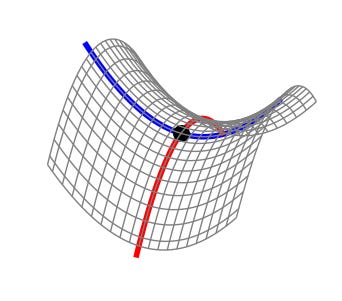
In dynamical systems theory, an equilibrium is a point at which an object will remain stationary, if it is located precisely. If you imagine a marble rolling around on the surface above, then that black dot where the red curve meets the blue curve is an equilibrium. Specifically, it is the type of equilibrium known as a saddle point, because a saddle has a similar “upwards in one direction, downwards in another” kind of curvature.
A saddle point is “stable” from some directions (like the blue line above); if the marble was free in that direction it would naturally move toward the equilibrium. It is "unstable” in other directions (like the red line above). On the red line, to draw the marble towards the equilibrium, you would need to apply some sort of external control, unless you were exactly on the equilibrium, at which point it would balance and remain still.
So I guess what I am saying is, control yourself in one way, and be free in another, and… apparently there is something that just happens once you get close enough? It seemed to.
If the idea of being controlled and free at the same time sounds confusing, think about what you would do if you were trying to think clearly about a complex issue. You would want to be controlled, in the sense that you would want to be carefully sifting through evidence, and making qualitative evaluations, and so on. But you’d want to be free, in that you’d want to be able to come to more than one answer, depending on the evidence. Imagine doing that, without compartmentalizing, and it should give you a rough idea. But there are other factors involved, too. For example, I think it mattered that I was in a state of trust, believing that I could respond subjectively without fear of being pushed around.
The practice of truthseeking without compartmentalization strikes me as notably under-studied, these days. On the one hand we have rationalists talking about how to be “high decouplers” who separate the facts from any distracting context, and on the other hand we have poetic types who talk about using “another kind of truth” that can be separated from all of this overbearing factual science. I will freely concede that both types of thinking have their uses, but I can’t help but think we are missing something.
Compartmentalization is of course a standard reductionist technique. The specific notion of “decoupling” as a skill gained traction amongst internet rationalists after a post from Sarah Constantin noted that the ability to think this way correlates both with intelligence and with better performance on a very specific subset of cognitive bias tests. Constantin’s description was fairly measured about the strengths and weaknesses of this reasoning style, writing that “Cognitive decoupling is the opposite of holistic thinking. It’s the ability to separate, to view things in the abstract, to play devil’s advocate.” In other words, it’s one way of thinking among many.
As is common with ideas on the internet, the concept quickly lost most of its nuance. Rationalists are, notoriously, often very fond of hearing that being smart makes them right about things. It was probably inevitable, given a contrast between detached “high decoupling” and contextual “low decoupling,” that some would conclude that the former is simply better—higher, if you will—than the latter.
I do not dislike detached or abstract reasoning; I have three mathematics degrees for a reason. Still, I get annoyed when I see “high decoupling” used as a synonym for “rational” or “tolerant.” The latter conflation is surprisingly common, because “decoupling” a potentially inflammatory idea from its context can indeed make it easier to contemplate dispassionately. However, tolerance as a virtue is entirely compatible with holistic thinking. If you need to not see the problem in order to tolerate it, then is that really tolerance?
I became particularly wary after a post on the Slate Star Codex subreddit suggested “low decoupling” might explain why some people are leery of discussions about race and IQ even when they come accompanied by cautious disclaimers about their conclusions. The subject of race and IQ is one of the last subjects where you ought to have a policy of simply ignoring contextual implications! There were, always, people in the forums I was frequenting who would covertly (or not-so-covertly) recruit for racist ideologies, sometimes with a little help from the dark version of rationalism in which ignoring your feelings becomes ignoring compassion. If compartmentalization was being used to inveigle people into dispassionate cruelty, then perhaps I ought to avoid it entirely, just to be safe.
The alternative to compartmentalizing a feeling is managing it. Most rationalist-adjacent people do a little of each, I think; few would advocate walling off a feeling if you can more fully ameliorate its capacity to distort your thinking by working through it. To attempt to see clearly while swearing off compartmentalization is therefore an ongoing exercise in personal development. One technique—simple enough in concept—is to learn to be aware of feelings without being controlled by them. Love somebody, and yet be able to see when they’re out of line. Fear somebody, and yet continue to hear them.
Wanting something to be true can make you more likely to believe it. There are some interesting trade-offs that arise when dealing with this. You can cultivate a desire for the truth that is stronger than your other wants, so that you can still be aware of the latter while reminding yourself that the former has higher priority. Alternatively or additionally, you can try to genuinely moderate your desires to reality, or just make your desires less strong overall. All three of these methods avoid compartmentalization, and they are at least partially interchangeable.
Some of my techniques are outright makeshift. If you look at those two moves I was making, prior to the existential drop in my previous piece, they each have a bootstrapping quality to them. I know I will keep my promise to return to the problem of becoming overly fanatical because (a) if the promise wasn’t good, I wouldn’t have the level-headedness needed to seek the truth in that direction and (b) I care a lot about truthseeking so (c) I am willing to make that promise and keep it.
This promise to myself is, again, kind of trade-off. It might be tempting to claim that such trade-offs can be avoided by walling off your feelings instead of paying the price necessary to neutralise them. However, compartmentalization is also a trade-off.
The sub-topic of morality has trade-offs, too. Moral impulses can be extremely powerful, and they can certainly distort your vision. You can falsely expect that something will happen because you think it ought to happen. You can find it hard to accept particular truths because you feel that they would imply moral claims on you. One way to handle this is to distance yourself from morality altogether. Nietzsche’s work has elements of this, but it’s also present, in a different way, in Taoism. “Wise souls aren’t humane,” says Ursula K. Le Guin in her translation of the Tao Te Ching, choosing her stark wording deliberately.
I suppose that I, too, have some of this moral distancing, because I can call on my existential freedom whenever I wish. Still, I consider this a technique of last resort. To prevent myself from expecting things to happen just because they ought to, I generally opt for the tragic worldview, in which good doesn’t always win. As for truths that might imply a moral claim on me, I’ve discussed that a bit in Sections V and VI of this piece. A central element is being able to accept that I’m flawed.
It is not a simple task to genuinely feel a flaw in yourself, without flinching from the underlying facts that imply this. Sometimes, lack of compartmentalization will naturally change your behaviour as a side effect; this is a good thing, if you ask me. Presumably, there are ways of confessing a sin and asking for absolution that also do these kinds of things, but I’m not Christian so I’ve abstracted out what I consider to be the necessary aspects. There is a sort of resonance point where the capacity to feel moral pain intersects with the ability to accept it and you can see both the facts involved and the moral conclusions that you’re coming to as a result.
I don’t know if that resonance point is also the point that saves your soul. It might be. It cannot be a coincidence that the saying about “first take the beam out of your own eye” is about, well, your eye. But I find the broader Christian elements distracting. They shift the components around in a way that makes things blurry—like a telescope, out of focus. If I were Christian, I might have the right to adjust my understanding of the concepts involved in order to sharpen the image. Since I’m not, I guess I’ve just sort of figured out how to take a couple of lenses and freehand it.

I have described this non-compartmentalized approach as a way to grow outward from something alongside rationalism, because that is roughly the way I learned it. From the more poetic end, I may be less qualified to give advice, but I think the first point I would note is that objective topics teach you things about yourself that you cannot afford to ignore. There are some ways of thinking that work better for science because they are particularly suitable in a reductionist context and may not apply outside of it; there are other ways of thinking that work better for science because they correct for human failings in a way that naturally carries over outside the scientific.
There are those who say, wistfully, that natural philosophy used to be about comprehending the mind of God. The rather contradictory implication of such statements is often that science is getting too big for its boots by bleeding outward into the metaphysical in ways that the speaker does not like. But some of the ways that science has changed our thinking are simply correct, even if they mess up our previous holistic understanding. This might seem unfair, but it’s just the way it is. Reductionism can get quite far without even considering its impact on holism, but a holism that reacts to a runaway reductionism by attempting to exclude it is a contradiction in terms.
To think both logically and poetically at the same time might sound threatening to someone who is used to suppressing feeling in order to be rational. Won’t the feelings pull at us? Can we be sure they won’t lead us astray? Yet to the advocates of poetry it might be equally threatening. What if we think logically, and something with deep resonance for us turns out not to be technically true, and we have to abandon it? What if we need that thing?
Even those with a foot in both camps might still be quite realistically aware of potential pitfalls. What if logic and poetry just don’t mesh? What if they make paradox after paradox when we attempt to take them both at once? Can’t we silo them each safely in some non-overlapping magisteria?
There are no guarantees that a more holistic approach will lead to true perception1, and I wouldn’t recommend applying non-compartmentalized methods to a question as big as this without practicing on smaller problems for a while, first. A controlled subjectivity will still give a greater variety of answers than a subjectivity that has been walled off, and different people who approach things holistically can reach different conclusions as a result.
Still, there are some questions in life to which it is natural to bring your whole self. I think this is one of them.
The next post in this series is here.
The philosopher Daniel Muñoz has a lovely recent post that explores the extent to which it is, or is not, possible to distinguish a philosophical trap from a true insight.